
AI content suitability is the practice of deciding, sub-type by sub-type, which AI-generated content a brand can appear next to and which it should exclude. It became a planning question in October 2026, when a DecryptAds investigation mapped 2,116 AI-generated recipe sites carrying ads from major brands, and Google reclassified fabricated author profiles as deception. This guide sets out what a Gulf advertiser needs to know and how to set a threshold.
What did the DecryptAds investigation find?
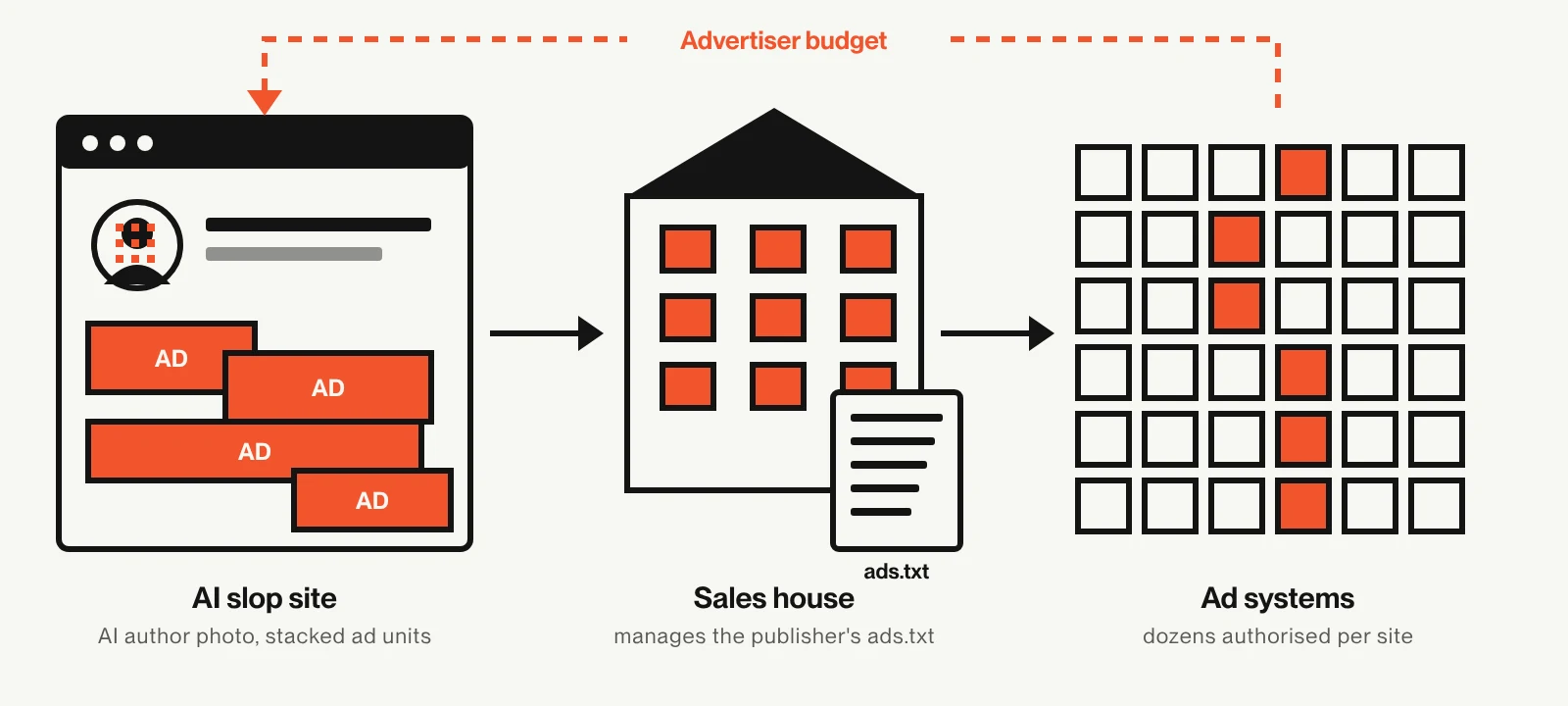
DecryptAds, an advertising supply chain intelligence company, published its report on 18 October 2026. Starting from about 400 recipe sites that used both AI-generated author photos and AI-generated text, the team built more than 190 technical fingerprints and traced 2,116 domains operated by the same clusters, with social accounts frequently tied to Morocco and Algeria. The pages carried overlapping ad units, invented chef biographies and, in at least one documented case, a malware lure.
The supply route is the lesson. The publishers outsource their ads.txt management to sales houses that authorise dozens of ad systems at once. Two sales houses accounted for 96.3% of the mapped sites. The publisher is paid by the sales house; the advertiser's demand-side platform sees a long reseller chain in which an AI content farm looks like any other small site.
Why does the "elevated risk" label include the UAE?
DecryptAds built its sample by screening ad systems registered in jurisdictions it ranks by risk: 81 in Russia, 85 in China, 26 in secrecy havens, and 104 in an "elevated risk" tier that lists the United Arab Emirates alongside Pakistan, Nigeria and Ukraine. The tier is a screening device based on corporate registration, not an audit of any company's content standards. One sales house quoted by AdExchanger responded that its regional partners operate under contractual data protection obligations aligned with GDPR.
For an advertiser in the GCC the implication is practical rather than reputational: expect international buyers and verification vendors to apply country-level filters, and expect regional supply partners to be asked for evidence of their vetting. The evidence that answers the question is behavioural: authorship disclosure, page purpose and a known partner list.
How much programmatic spend reaches MFA inventory?
- Pixalate's benchmark for Q1 2025 put made-for-advertising domains at 10% of global open programmatic web spend, and 10% in EMEA.
- IAS's 21st Media Quality Report (July 2026) found that mobile web display accounts for 45.1% of measured impressions but 71.9% of MFA impressions; the MFA rate was 2.0% on mobile web against 0.5% on desktop.
- The ANA's 2023 transparency study, the first large measurement, found 21% of impressions and 15% of spend on MFA sites among the companies studied.
Mobile-first markets such as Saudi Arabia and the UAE are therefore more exposed through display than through video, and the first control is inventory selection on mobile web.
What do Google and YouTube now treat as low quality?
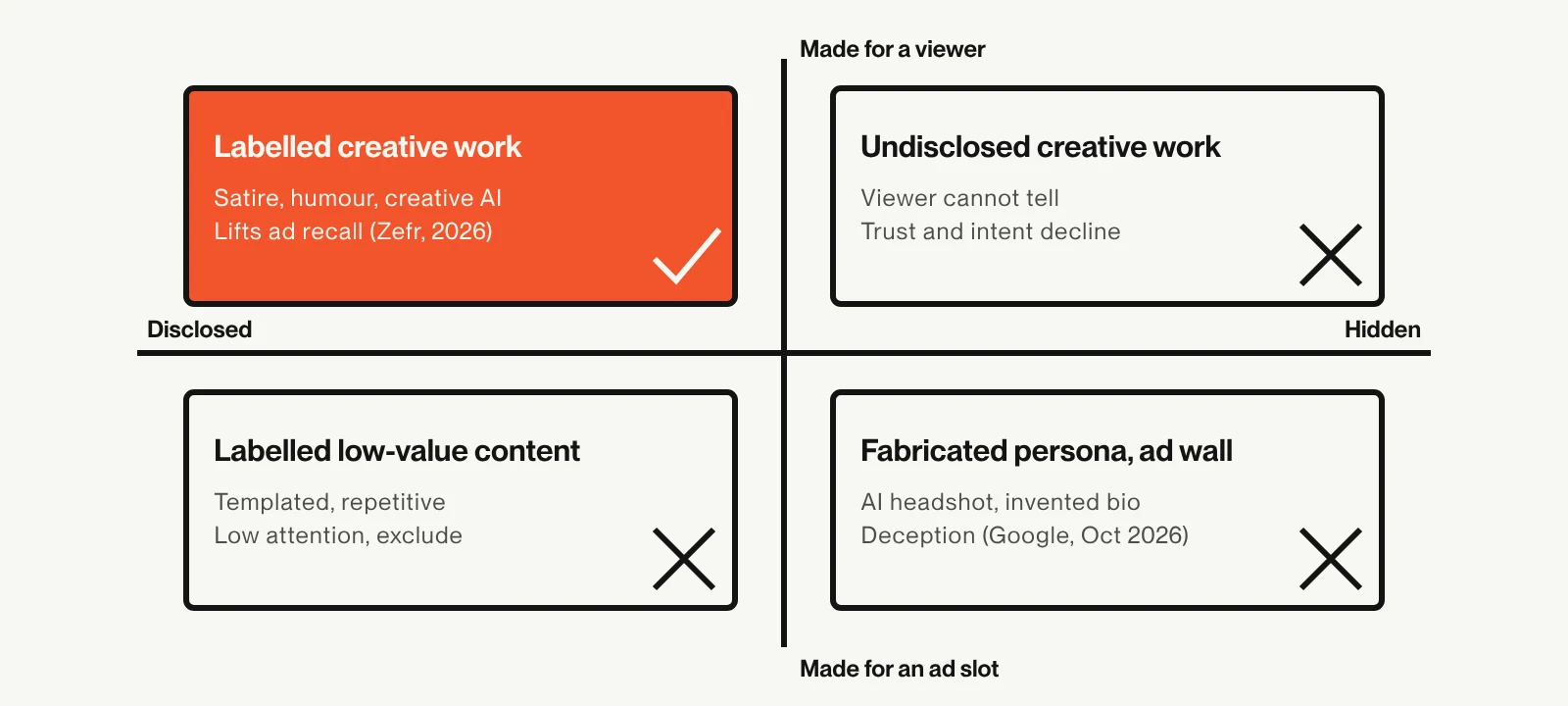
On 1 October 2026 Google's helpful content guidance added that fabricating creator profiles with AI-generated headshots, made-up names or false credentials is a form of deception and a signal of a low-quality page. AI-assisted content itself stays eligible for Search. YouTube, in its Partner Program, replaced "repetitious content" with "inauthentic content" and excluded from monetisation AI characters that give advice on topics such as finance and health. Platform enforcement sets a floor; it does not set a brand's own threshold.
Is AI content itself the risk?
Not by category. Zefr and OM Media Trials published in March 2026 the first study to measure ad performance next to different types of AI-generated content, using a consumer panel in the United States and Canada:
| Finding | Figure |
|---|---|
| Respondents who misidentified human-made content as AI | 32% |
| Respondents who named at least one AI content type unsuitable for brands | 81% |
| Respondents more positive about a brand when AI content is labelled | 41% |
| Effect of ambiguous content (viewer cannot tell AI from human) | Favourability, trust and purchase intent decline |
| Effect of satire, humour and creative AI content | Ad recall and perceived innovation rise |
The pattern is the same as Google's: deception and ambiguity carry the risk, labelled creativity does not. The panel is North American; no equivalent GCC panel has been published.
What does a content-level control change in practice?
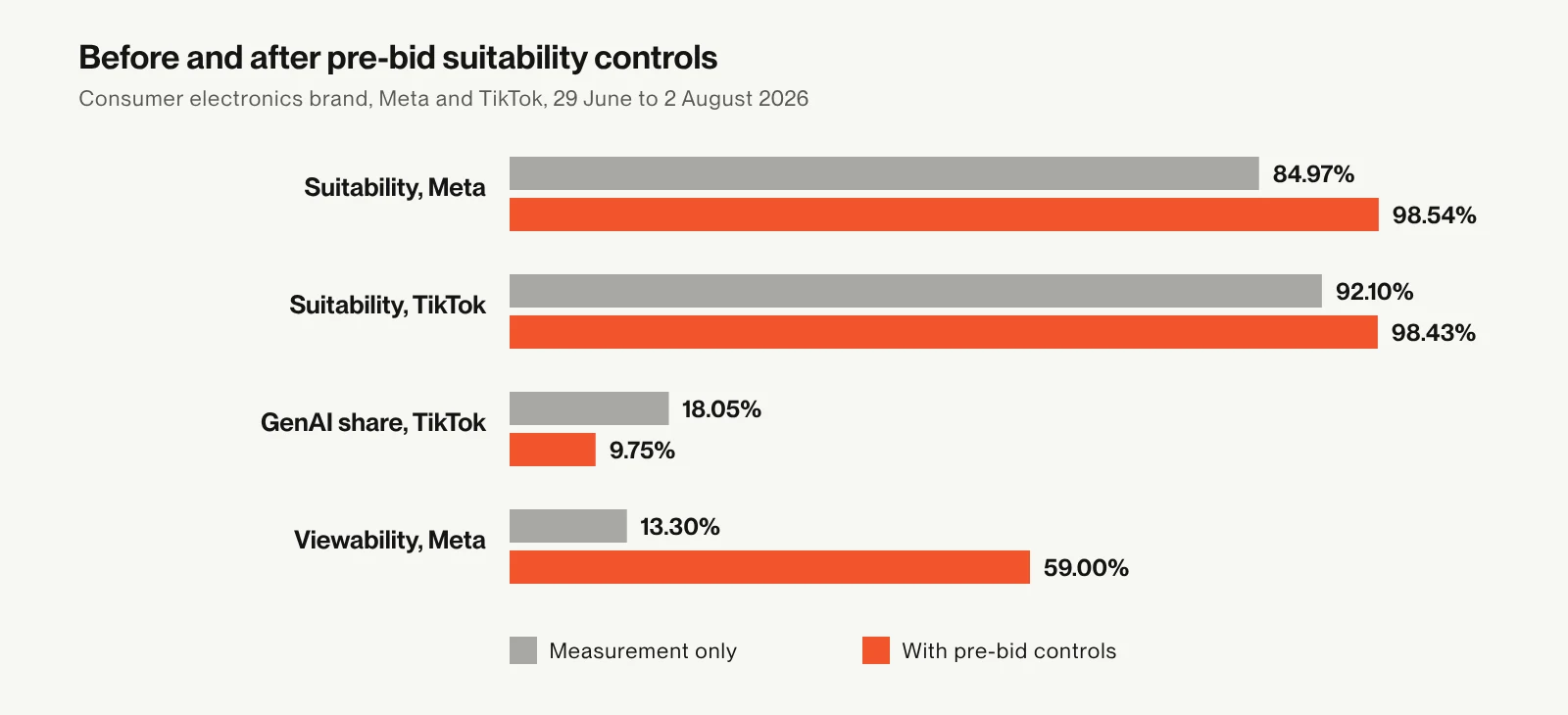
A two-phase test on Meta and TikTok for a consumer electronics brand in Central Asia, run between 29 June and 2 August 2026, shows the mechanics. Phase one measured delivery under native platform settings only. Phase two applied Zefr pre-bid suitability controls, with generative AI content added to the exclusions from 24 July.
| Metric | Measurement only | With pre-bid controls |
|---|---|---|
| Brand suitability, Meta | 84.97% | 98.54% |
| Brand suitability, TikTok | 92.10% | 98.43% |
| Share of impressions next to GenAI content, TikTok | 18.05% | 9.75% |
| Viewability, Meta | 13.3% | 59.0% |
Two limits: this is a single advertiser over five weeks, and a change in one metric did not move the others automatically; TikTok viewability did not change in the same test. The figures describe that campaign, not an expected rate.
How should a GCC advertiser set an AI suitability threshold?
- Split AI content into sub-types. Creative and clearly labelled content on one side; undisclosed personas, spam-like generation and misleading depictions on the other. Decide each separately.
- Require disclosure, not absence. Google's rule is a workable standard: an undisclosed AI author is a low-quality signal; a labelled one is a judgement call.
- Classify at content level. Channel labels and page categories do not see the video or the page. Frame, audio and text classification does.
- Control mobile web display first. It carries most MFA exposure in the IAS data.
- Ask the supply chain for its partner list. ads.txt and sellers.json show who is authorised; a sales house that cannot name its ad systems is the finding.
- Run a measurement-only phase before controls. A baseline makes the effect of the threshold visible and defensible.
Key points
- DecryptAds mapped 2,116 AI-generated recipe sites that reached major brands' budgets through outsourced sales houses.
- The UAE sits in the report's "elevated risk" tier by corporate registration; the test that matters for buyers is behavioural.
- Google now treats fabricated creator profiles as deception; YouTube does not monetise inauthentic content.
- Zefr's research shows risk follows deception and ambiguity, not AI as a category.
- In a Meta and TikTok test, pre-bid controls raised brand suitability to above 98% and halved the share of impressions next to GenAI content on TikTok.
Sources: DecryptAds, AI Recipe Slop Networks, 18 October 2026; AdExchanger, 20 October 2026; Search Engine Journal on Google's 1 October 2026 guidance; Zefr and OM Media Trials, AI Slop or Not?, 2 March 2026; MediaPost on Pixalate's Q1 2025 MFA benchmark; ANA Programmatic Media Supply Chain Transparency Study, December 2023; IAS Media Quality Report, 21st edition, July 2026; Zefr media quality test report, August 2026.